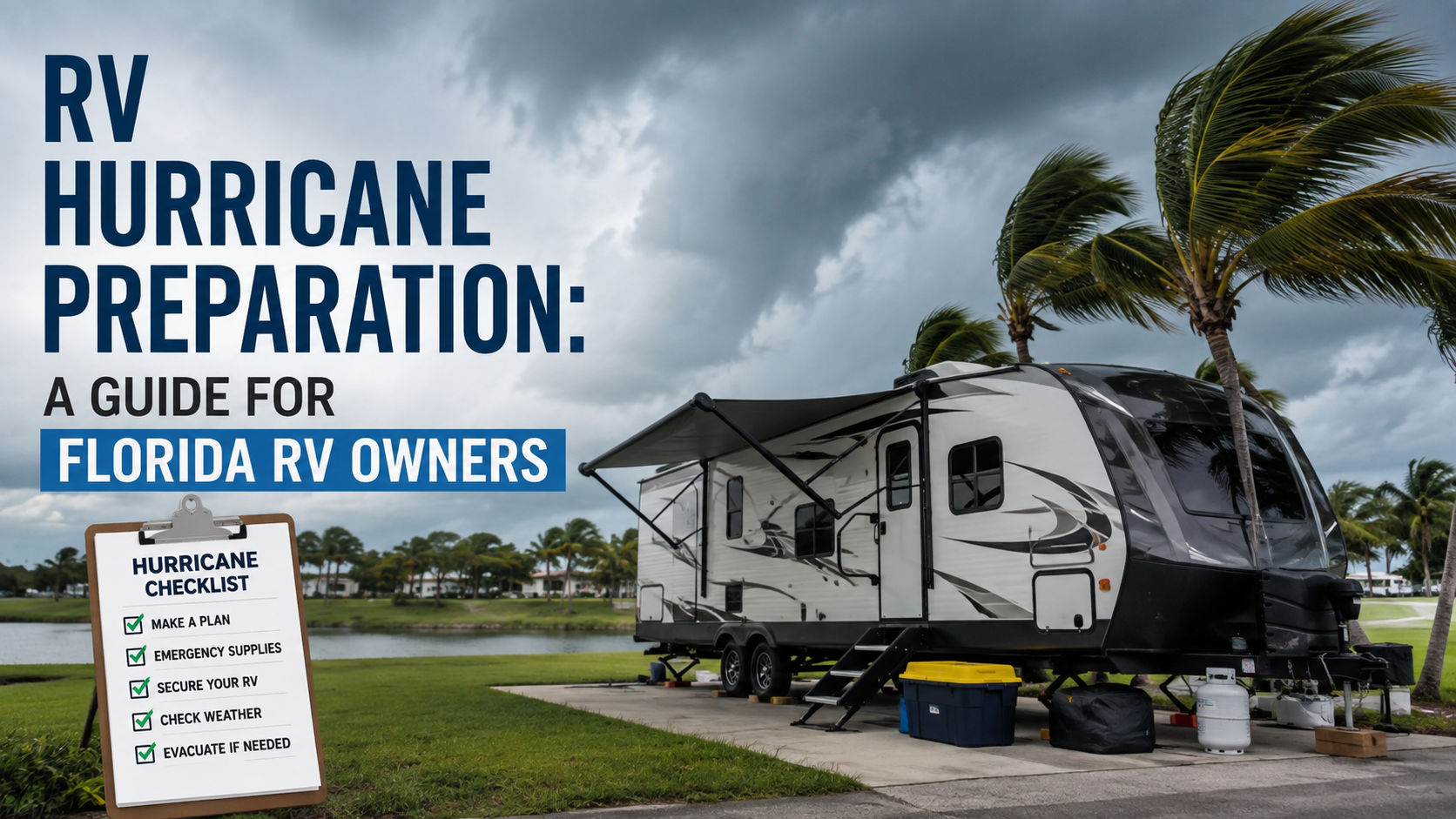
Living or traveling in an RV gives you a level of freedom that traditional housing simply cannot offer. In Florida, however, RV owners also need to be prepared for one of the state’s biggest weather threats: hurricanes and tropical storms.
Florida’s hurricane season officially runs from June 1 through November 30, and storms can bring powerful winds, heavy rainfall, flooding, tornadoes, and widespread power outages. While preparing for a hurricane is important for every Florida resident, RV owners face additional challenges because recreational vehicles are particularly vulnerable to high winds and flying debris.
Whether you live in your RV full-time, stay at an RV community for several months, or travel throughout Florida, having a hurricane plan before a storm develops can make a significant difference. The key is preparing early rather than waiting until a hurricane is already approaching.
Here are some of the most important steps Florida RV owners should take to prepare for hurricane season.
Understand That an RV Is Not a Hurricane Shelter
The most important thing for RV owners to understand is that an RV should never be considered a safe place to ride out a hurricane.
Even large fifth wheels, motorhomes, and travel trailers can be vulnerable to strong winds. RVs have relatively large exterior surfaces and comparatively lightweight construction, which can make them susceptible to tipping, shifting, or sustaining significant damage during severe weather.
Your first priority should always be the safety of yourself, your family, and your pets.
If local emergency management officials issue an evacuation order for your area, follow their instructions. Do not remain inside an RV simply because it is secured, stabilized, or protected by nearby trees or structures.
Having an evacuation plan established well before hurricane season eliminates many last-minute decisions.
Create Your Hurricane Evacuation Plan Early
One advantage RV owners have is mobility, but that advantage disappears quickly if you wait too long.
When a hurricane threatens Florida, thousands of residents may begin traveling away from the projected path. Highways can become congested, fuel stations can become crowded, and hotels and campgrounds outside the affected area may fill quickly.
Decide ahead of time where you could go if evacuation becomes necessary.
Depending on the storm’s projected path, this could mean traveling farther inland, heading to another part of Florida, or leaving the state entirely.
Identify several possible evacuation routes instead of relying on one highway. Hurricanes can change direction, and certain roads may experience closures, flooding, accidents, or severe congestion.
If you are staying in a long-term RV community, familiarize yourself with nearby major roads and evacuation routes as soon as you arrive.
Keep Your RV Ready to Move
During hurricane season, long-term RV residents should avoid allowing their RVs to become difficult to relocate.
It is easy for an RV site to gradually become more permanent. Outdoor furniture gets added, decorations go up, storage containers accumulate, and equipment gets positioned around the RV.
When a storm approaches, all of those items must either be secured or moved.
Keep your RV maintained and road-ready throughout hurricane season. Check tires regularly for proper inflation, cracking, or excessive wear. Make sure your brakes, lights, batteries, and towing equipment are in good condition.
Motorhome owners should periodically check the engine and starting battery as well.
If your RV hasn’t moved in several months, don’t wait until an evacuation is necessary to discover a mechanical problem.
Know Your RV’s Height, Weight, and Clearance
If you need to evacuate quickly, you may end up traveling unfamiliar roads.
Keep your RV’s important measurements somewhere easily accessible, including its total height, width, length, and approximate weight.
This information can help you avoid roads with low bridges, weight restrictions, or other obstacles.
Remember that your RV’s actual height may include rooftop air conditioners, antennas, satellite equipment, and other accessories.
Planning your evacuation route with your RV’s size in mind can prevent an already stressful situation from becoming considerably more difficult.
Prepare an Emergency Supply Kit
Every Florida RV owner should maintain an emergency kit during hurricane season.
Your kit should contain enough essential supplies to get you through several days if electricity, water, fuel, or other services become temporarily unavailable.
Important supplies can include bottled water, nonperishable food, medications, flashlights, batteries, portable phone chargers, basic tools, first-aid supplies, hygiene products, important documents, and weather-resistant clothing.
RV owners should also keep supplies specifically for their vehicle, including tire-changing equipment, leveling equipment, electrical adapters, hoses, extension cords rated for appropriate use, and basic repair supplies.
Don’t forget your pets. Keep extra pet food, water, medications, leashes, carriers, and vaccination records readily available.
Monitor the Weather Regularly
Florida residents quickly become accustomed to seeing tropical systems develop during hurricane season. However, storms can strengthen or change direction rapidly.
Monitor reliable weather forecasts regularly, particularly when a tropical disturbance enters the Atlantic Ocean, Caribbean Sea, or Gulf.
Pay attention to information from the National Hurricane Center and local emergency management agencies rather than relying entirely on social media forecasts.
Understanding the difference between watches and warnings is also important.
A hurricane watch means hurricane conditions are possible within the specified area. A hurricane warning means hurricane conditions are expected.
For RV owners, waiting until a warning has been issued may leave very little time to relocate.
Fill Your Fuel Tank Before the Rush
Fuel availability can become a major concern when a hurricane approaches.
Gas stations along evacuation routes may experience long lines, and some stations may temporarily run out of fuel.
Keep your tow vehicle or motorhome adequately fueled throughout hurricane season. When a storm begins posing a realistic threat to Florida, consider filling your tank before evacuation activity increases.
If you use a generator, make sure you understand how to transport and store fuel safely and legally.
Never operate a portable generator inside your RV, underneath an awning, or near doors, windows, or vents where carbon monoxide could enter the living space.
Secure Outdoor Items Before Leaving
If you evacuate your RV but leave it at the RV community, anything surrounding your site needs to be secured.
Patio chairs, grills, tables, bicycles, decorations, rugs, storage containers, toys, and other loose objects can become dangerous projectiles in hurricane-force winds.
Retract your awning completely. RV awnings are particularly vulnerable during severe weather and can suffer significant damage even during relatively ordinary thunderstorms.
Remove or retract antennas and other exterior accessories when possible.
Anything that can safely be brought inside should be stored before you leave.
Disconnect Utilities When Appropriate
Depending on the situation and instructions from your RV community, you may need to disconnect utilities before evacuating.
This can include electrical connections, freshwater hoses, sewer connections, and other equipment.
Know how to properly disconnect your RV and prepare it for travel before an emergency occurs.
Keeping hoses, electrical cords, adapters, and other equipment organized can make departure considerably faster.
If you’re unsure about procedures at your particular RV community, ask management about its severe-weather policies before hurricane season.
Protect Important Documents
Important documents should be easy to access if you need to evacuate.
Consider keeping your driver’s license, vehicle registration, RV registration, insurance information, medical information, emergency contacts, and pet records together in a waterproof container.
Digital copies can provide additional protection. Store important documents securely online or on a device you can take with you.
Photograph your RV and belongings before hurricane season as well. Current photos can be useful if you eventually need to document storm damage for an insurance claim.
Review Your RV Insurance Coverage
Hurricane season is a good time to review your RV insurance policy.
Don’t assume every type of hurricane-related damage is automatically covered.
Review your policy to understand coverage for wind, flooding, falling trees, debris, personal belongings, towing, temporary lodging, and other potential expenses.
If you live in your RV full-time, make sure your insurance company knows how the RV is being used.
Ask questions before a storm occurs rather than trying to determine your coverage after damage has already happened.
Have a Plan for Pets
Pets add another consideration to hurricane evacuation planning.
If you plan to stay at a hotel, campground, shelter, or with friends or family, confirm ahead of time that your animals will be permitted.
Pet-friendly accommodations can fill quickly during major evacuations.
Keep carriers, leashes, food, medications, bowls, identification tags, and veterinary records ready to go.
If your pet becomes anxious during storms or long drives, discuss appropriate options with your veterinarian before hurricane season.
Don’t Return Too Quickly After a Hurricane
Once a storm passes, it can be tempting to return immediately.
However, conditions can remain dangerous long after the wind stops.
Flooded roads, downed trees, damaged bridges, debris, power lines, and traffic restrictions can make returning difficult or unsafe.
Wait until local officials indicate that returning to the area is appropriate.
When you return to your RV, inspect the exterior carefully before reconnecting utilities. Look for roof damage, broken windows, damaged electrical equipment, water intrusion, shifted stabilizers, and other signs of storm damage.
If you suspect electrical or structural damage, have the appropriate professional inspect it before using the affected system.
Prepare Before a Storm Is on the Map
One of the best hurricane preparation strategies is also the simplest: don’t wait.
Once a hurricane is approaching Florida, supplies disappear quickly, roads become crowded, and everyone begins trying to accomplish the same preparations at the same time.
Instead, prepare at the beginning of hurricane season.
Build your emergency kit, inspect your RV, review your insurance, identify evacuation routes, organize important documents, and determine where you could stay.
Then, if a storm threatens your area, your focus can be on making a safe decision rather than scrambling to get ready.
Long-Term RV Living in North Florida
For RV owners who spend extended periods in Florida, choosing the right RV community is an important part of planning for everyday life as well as severe weather.
First Coast RV Community provides a comfortable option for extended-stay RV living in North Florida. With spacious RV sites, full hookups, a peaceful setting, and convenient access to the Jacksonville area, residents can enjoy the flexibility of RV living while establishing a place that feels more like home.
Hurricane preparedness is simply part of living in Florida. With an RV that is ready to travel, a well-planned evacuation route, essential supplies, and an understanding of local emergency procedures, RV owners can approach hurricane season with greater confidence.
The most important rule is to prioritize people over property. RVs and belongings can be repaired or replaced. When local officials recommend or require evacuation, leave early, follow trusted weather information, and get yourself, your family, and your pets to a safe location.
